<?xml version="1.0" encoding="utf-8"?><feed xmlns="http://www.w3.org/2005/Atom" ><generator uri="https://jekyllrb.com/" version="3.10.0">Jekyll</generator><link href="https://codingbobby.xyz/feed.xml" rel="self" type="application/atom+xml" /><link href="https://codingbobby.xyz/" rel="alternate" type="text/html" /><updated>2025-05-30T18:15:17+00:00</updated><id>https://codingbobby.xyz/feed.xml</id><title type="html">CodingBobby</title><subtitle>Personal blog of Bob, talking about what interests him and what he learned today. He is also showing his projects and lists useful resources for developers and science students.</subtitle><author><name>Bob Walter</name></author><entry><title type="html">Dance, Organisms, War and Melodies</title><link href="https://codingbobby.xyz/blog/dancing-organisms/" rel="alternate" type="text/html" title="Dance, Organisms, War and Melodies" /><published>2024-11-20T00:00:00+00:00</published><updated>2024-11-20T00:00:00+00:00</updated><id>https://codingbobby.xyz/blog/dancing-organisms</id><content type="html" xml:base="https://codingbobby.xyz/blog/dancing-organisms/"><![CDATA[<p>I have already talked about the work of <em>Alastair Reynolds</em> several times here<sup id="fnref:mentioning-reynolds" role="doc-noteref"><a href="#fn:mentioning-reynolds" class="footnote" rel="footnote">1</a></sup>, but I just can’t stop, so here we go again.
The more I dive into it, the more time I spend with it and the longer I live, the more I realise how great all of this is.
Let me explain.</p>

<h2 id="dance">Dance</h2>
<p>Recently, I have watched the piece “Superorganism” by a jugglery group called <em>Critical Mess</em><sup id="fnref:critical-mess" role="doc-noteref"><a href="#fn:critical-mess" class="footnote" rel="footnote">2</a></sup>.
It was unexpected and I didn’t really plan to see it, so I didn’t anticipate anything.
I was just there by chance.
But I’m so grateful for that because it was immensely beautiful.
In fact, it was so beautiful that I was standing there with shaky legs, unable to move or look away.
Perhaps, only I experienced this feeling – afterwards, I heard the people around me talk about the skills of the performers, how they never dropped their juggling balls and so on.
Yes, they really mastered their technical skills.
It was flawless.
But that wasn’t what I cared about.</p>

<p>Their group was seven people plus a DJ, and I’ve noticed how different their characters are, yet they worked together as if controlled by a single mind.
Somebody launched up a ball at one end of the stage, others emphasised the moment by fluent directional movements, and another, unpredictable person shot out an arm in just the right instance to grab the ball mid-flight.
It wasn’t obvious but they were perfectly in sync at any point in time.
The performance had several layers of undulation: The overall shape formed stars, flowers, waves and suddenly sharp needles; the white balls standing out from the background moved in circles and parabolas, spreading out and coming in, suddenly vanishing behind the performers, suddenly all up in the air; and even on the smallest scale hands and fingers gestured precisely to the flow yet uniquely did their own thing.
It started slowly, one action after the other, sped up and produced complexity, calmed down and grew again.
It didn’t seem scripted at all.
To me, it felt as if it emerged organically before my eyes.
The DJ made this even more pronounced as he indeed improvised the electronic music on the fly.
It matched the perfomance so well that he seemed to steer the evolving organism and command it where and how to move.
I dont’t remember the music – I remember how it felt.
The whole thing didn’t stop for a second in 45 minutes and it was so chaotic, organic and beautiful.</p>

<h2 id="organisms">Organisms</h2>
<p>Like chaos.
It reminded me heavily of the strange chaos of mathematical attractors<sup id="fnref:strange-attractors" role="doc-noteref"><a href="#fn:strange-attractors" class="footnote" rel="footnote">3</a></sup>.
Being completely deterministic you won’t think they will be able to evolve unpredicably.
But Edward Lorenz has proven otherwise.
Obviously, “Superorganism” couldn’t strictly be deterministic as the performers had free will (I’m believing that we all have), but the piece itself was created so that it really felt deterministic.
Every movement felt purposeful and the only logical consequence to what happened before, like a chemical reaction falling into a specific direction, like a optimisation algorithm finding a specific local minimum among many others.
It was completely unpredictable.
Evolution creates things unimagineable, but it wouldn’t have happened if the infinitesimally close step before hadn’t occured.
What was before?
The begininning is always the hardest thing to answer.
This piece definitely had a beginning, but after a minute into it I couldn’t tell there was.
As if it had been going forever.
Endless forms most beautiful.</p>

<p>Most coincidentally, I was reading Alastair Reynolds’ short stories collected in “Galactic North”<sup id="fnref:galactic-north" role="doc-noteref"><a href="#fn:galactic-north" class="footnote" rel="footnote">4</a></sup> at the time.
It fitted the performance so perfectly that I thought that I was looking straight into it.
In the <em>Revelation Space</em> universe created by Reynolds, a human faction called the Conjoiners are linked in a vast intelligent network.
They all share the same memories and exchange thought in real time.
In “The Great Wall of Mars” their existance was elaborated in more detail, how and why, and why you can’t believe it unless you have experienced it yourself.
And then you will never want to go back – the <em>Transenlightenment</em>.
Particles of warm light flow along paths through the physical world and form information like a hologram right in your mind.
You could see intelligence itself.
The white juggling balls reminded me of this.
Crossing from person to person they exchanged information and directed the game.
They emerged from the people but were used by the people complementarily.
Seperated from their flock, a lone Conjoiner would feel deeply broken, they cannot live that way.
What would a lone perfomer do?
The organism would be wounded and it couldn’t continue its evolution around the separated person.
They must stay within reach of thought.
Everybody contributes their own ideas but there will never be an odd one out.
Like neurons choosing their own weight and subtly but surely changing the whole brain’s behaviour without ever disrupting its flow.</p>

<h2 id="war">War</h2>
<p>In another of Reynolds’ short stories, “Nightingale”, people find an intelligence that was isolated for a long time.
Originally it was meant to run a hospital in space, but it has turned crazy, mad, insane.
Growing body parts and harvesting tissue in a space-station-sized factory, it continued to operate a single doomed human for decades.
It turned him into a work of art – a living replica of <em>Guernica</em>.
<em>Guernica</em>, the almost 8 m wide oil painting by Pablo Picasso<sup id="fnref:reynolds-work" role="doc-noteref"><a href="#fn:reynolds-work" class="footnote" rel="footnote">5</a></sup>.
It is perhabs the most powerful anti-war artwork ever created, addressing the brutal and horrific bombing of the Spanish town of Guernica by Nazi Germany during the Spanish Civil War in 1937.
The attack was pure evil, destroying a defenseless rural town, violently killing hundreds of innocent civilians.
Picasso disturbed the art community and made one of the boldest statements against war.
The Nightingale hospital intended the same after stopping to heal soldierst only to send them back into the massacre.
But it did so in the most revolting way imaginable.
It doesn’t make sense to fight cruelty with cruelty.
Yet it doesn’t get more effective.
Looking at <em>Guernica</em> and the depicted suffer, it strikes you with disgust, anguish and sorrow.
And as the artwork is a reaction to war, you will project these feelings onto war and not the painting itself.
The painting remains beautiful.</p>

<p>Another incredible work of art so powerful it will surely make you cry are the <em>Hiroshima Panels</em> by Iri &amp; Toshi Maruki, and if you haven’t heard of them, you now have.
If I ever get to visit the Maruki Gallery to see these 15(-1) utterly terrifying 1.80 m by 7.20 m paintings in their true size and detail, I know that I wouldn’t be able to stand on my feet for long.
Please see and read about them on the <a href="https://marukigallery.jp/en/hiroshimapanels/" target="_blank">gallery</a> website.<sup id="fnref:linked" role="doc-noteref"><a href="#fn:linked" class="footnote" rel="footnote">6</a></sup></p>

<h2 id="melodies">Melodies</h2>
<p>Getting back to the brilliant music created by the musician of Critical Mess, Fabian Laute, I haven’t heard many similar things.
One moment I was standing in a jungle of whispering leafs and chirping birds, the other instant looking at crashing ocean waves, and a minute later there was alien technology communicating through cryptic codes.
The soundtrack created a pleasing but unfamiliar atmosphere.
It was deeply integrated into the performance, like the breathing that comes with living.
Living is the result of breathing and breathing the result of living.
One cannot be without the complementary other.
It somewhat reminded me of Neurotech’s <em>Symphonies</em><sup id="fnref:neurotech" role="doc-noteref"><a href="#fn:neurotech" class="footnote" rel="footnote">7</a></sup> or Nigel Stanford’s <em>Entropy</em><sup id="fnref:nigel-stanford" role="doc-noteref"><a href="#fn:nigel-stanford" class="footnote" rel="footnote">8</a></sup> and some pieces by Solar Fields<sup id="fnref:solar-fields" role="doc-noteref"><a href="#fn:solar-fields" class="footnote" rel="footnote">9</a></sup>.
Right now, I can’t really tell how “Superorganism” sounded like – as I said, I can’t remember it and just a feeling is left within me.
Though, you can get a hint of it in their trailer video<sup id="fnref:critical-mess:1" role="doc-noteref"><a href="#fn:critical-mess" class="footnote" rel="footnote">2</a></sup> and the other performaces by Fabian Laute.
I often associate songs or tracks to specific things, and if I come across the music or the thing, I instantly think of the other.
The feeling from watching “Superorganism” now comes up whenever I read the <em>Revelation Space</em> series.
The organic flow and growth, the grand scale and web of interconnections, the evolution of human nature was and still is not easy to put into words for me.
Now I collected another feeling I can associate with these things.</p>

<p>Perhaps my favourite short story by Reynolds is called “Weather” (which is also in the book mentioned before).
To cite a conversation of a shipmaster and the Conjoiner who was rescued from a hostile lightship:</p>

<blockquote>
  <p>“Inigo Standish, shipmaster. And you still haven’t told me your name.”</p>

  <p>“I told you: it’s nothing you could understand. We have our own names now, terms of address that can only be communicated in the Transenlightenment. My name is a flow of experiential symbols, a string of interiorised qualia, an expression of a particular dynamic state that has only ever happened under a conjunction of rare physical conditions in the atmosphere of a particular kind of gas giant planet. I chose it myself. It’s considered very beautiful and a little melancholy, like a haiku in five dimensions.”</p>

  <p>“Inside the atmosphere of a gas giant, right?”</p>

  <p>She looked at me alertly. “Yes.”</p>

  <p>“Fine, then. I’ll call you Weather.”</p>

  <p><span class="align-right">– Alastair Reynolds</span></p>
</blockquote>

<p>It’s nothing we could understand.
Through chaos theory, I think we might have come close to it.
If we were to find the rare event of the beautiful dynamic state Weather has chosen to be her name.
How long is the name?
Can it be expressed with sounds?
Would it have a melody?
I want to understand it so badly.
Maybe, I have caught a glimpse of it in the performance of Critical Mess.
And now I want to see it again.</p>

<p>Don’t forget to appreciate the beauty of us humans and what we can create, and that it should forever stand above all evil in its greatness.
Have a great day.</p>

<hr data-content="footnotes" />

<div class="footnotes" role="doc-endnotes">
  <ol>
    <li id="fn:mentioning-reynolds" role="doc-endnote">
      <p>Search for “Reynolds” on my <a href="/search?q=Reynolds">search-page</a>. <a href="#fnref:mentioning-reynolds" class="reversefootnote" role="doc-backlink">&#8617;</a></p>
    </li>
    <li id="fn:critical-mess" role="doc-endnote">
      <p>The jugglery collective <em>Critical Mess</em> is led by <a href="https://www.stefansing.com/" target="_blank">Stefan Sing</a> who is accompanied by Kate Boschetti, Tobi Dohm, Noah Schiltknecht, Liam Wilson, Mitja Ley and Viola Dix. You can find a short trailer video of the performance “Superorganism” on <a href="https://youtu.be/ijeHcnMQqtM" target="_blank">youtube</a> and a few words about it on Stefan Sing’s <a href="https://www.stefansing.com/critical-mess-superorganism-2023-now/" target="_blank">project page</a>. The music is composed by <a href="https://fabianlaute.com/" target="_blank">Fabian Laute</a> and you can listen to many of his improvised live performances on <a href="https://soundcloud.com/fabianlaute" target="_blank">soundcloud</a>. <a href="#fnref:critical-mess" class="reversefootnote" role="doc-backlink">&#8617;</a> <a href="#fnref:critical-mess:1" class="reversefootnote" role="doc-backlink">&#8617;<sup>2</sup></a></p>
    </li>
    <li id="fn:strange-attractors" role="doc-endnote">
      <p>I’ve dedicated a whole page for the strange attractors <a href="/projects/chaotic-shapes">here</a>. <a href="#fnref:strange-attractors" class="reversefootnote" role="doc-backlink">&#8617;</a></p>
    </li>
    <li id="fn:galactic-north" role="doc-endnote">
      <p>Find reviews and information about “Galactic North” on <a href="https://www.goodreads.com/book/show/89188.Galactic_North" target="_blank">Goodreads</a>. <a href="#fnref:galactic-north" class="reversefootnote" role="doc-backlink">&#8617;</a></p>
    </li>
    <li id="fn:reynolds-work" role="doc-endnote">
      <p><em>Revelation Space</em> isn’t just random science-fiction, it is an extension of human history. It feels real and as if this can surely happen to us. I love how it feels so strangely alien but still reasonable, clearly originating from the history we know. There are references to our present, like <em>Guernica</em>. Things that are still known to humanity two thousand years into the future, highlighting their utter importance. Today being not completely inconsequential is beautiful on its own. <a href="#fnref:reynolds-work" class="reversefootnote" role="doc-backlink">&#8617;</a></p>
    </li>
    <li id="fn:linked" role="doc-endnote">
      <p>I usually put links into these footnotes to not disturb your reading flow, but seeing the Hiroshima Panels for yourself is so important that I’ve linked them in the text. If you haven’t seen them yet, it’s perhaps the most important thing to do for you today. Do it now. <a href="https://marukigallery.jp/en/hiroshimapanels/" target="_blank">Here</a> is the link again, and take your time. It’s not meant to be easy.<sup id="fnref:poems" role="doc-noteref"><a href="#fn:poems" class="footnote" rel="footnote">10</a></sup> <a href="#fnref:linked" class="reversefootnote" role="doc-backlink">&#8617;</a></p>
    </li>
    <li id="fn:neurotech" role="doc-endnote">
      <p>You can get the “Symphonies II” album by Neurotech on <a href="https://neurotech.bandcamp.com/album/symphonies-ii" target="_blank">Bandcamp</a>. <a href="#fnref:neurotech" class="reversefootnote" role="doc-backlink">&#8617;</a></p>
    </li>
    <li id="fn:nigel-stanford" role="doc-endnote">
      <p>Listen to “Entropy” by Nigel Stanford on <a href="https://tidal.com/browse/track/38139040?u" target="_blank">various streaming services</a>. <a href="#fnref:nigel-stanford" class="reversefootnote" role="doc-backlink">&#8617;</a></p>
    </li>
    <li id="fn:solar-fields" role="doc-endnote">
      <p>The “Movements” album by Solar Fields is on <a href="https://solarfields.bandcamp.com/album/movements" target="_blank">Bandcamp</a>. <a href="#fnref:solar-fields" class="reversefootnote" role="doc-backlink">&#8617;</a></p>
    </li>
    <li id="fn:poems" role="doc-endnote">
      <p>If that wasn’t enough for you, Toshi Maruki has written poems (sounds much more peaceful than they are) about each panel. You can find an archived website with them on the <a href="https://web.archive.org/web/20160420085512/http://www.aya.or.jp/~marukimsn/gen/gen1e.html" target="_blank">Internet Archive</a>. <a href="#fnref:poems" class="reversefootnote" role="doc-backlink">&#8617;</a></p>
    </li>
  </ol>
</div>]]></content><author><name>Bob</name></author><category term="art" /><category term="science-fiction" /><category term="mathematics" /><category term="music" /><category term="journal" /><summary type="html"><![CDATA[I have already talked about the work of Alastair Reynolds several times here1, but I just can’t stop, so here we go again. The more I dive into it, the more time I spend with it and the longer I live, the more I realise how great all of this is. Let me explain. Search for “Reynolds” on my search-page. &#8617;]]></summary></entry><entry><title type="html">Updates After Yet Another Pi-Day</title><link href="https://codingbobby.xyz/blog/already-pi-day/" rel="alternate" type="text/html" title="Updates After Yet Another Pi-Day" /><published>2024-03-14T00:00:00+00:00</published><updated>2024-03-14T00:00:00+00:00</updated><id>https://codingbobby.xyz/blog/already-pi-day</id><content type="html" xml:base="https://codingbobby.xyz/blog/already-pi-day/"><![CDATA[<p>Happy \(\pi\)-day again!
Damn, already.
And I noticed this just the day before yesterday and suddenly felt the need to finally write a blog again.
There have been a lot of things happening in the meantime.
It’s not that I’m a super active person doing so crazy many projects which I’m busy with all day along, but still, I didn’t find much time for myself without some kind of stress related to “things need to be finished in \(x\) days”.
So here is a little wrap-up of some interesting things that happened.
Nothing related to \(\pi\), unfortunately. Please enjoy Matt Parker’s <a href="https://youtu.be/LIg-6glbLkU">video</a> for any celebration purposes.</p>

<h2 id="university">University</h2>
<p>Good news! Last year, I’ve become an actual engineer and I earned my <em>Bachelor of Science</em>.
Wohoo.
What do I do with it now?
Well, the masters of course.
I’m currently leaning more towards academia even though I initially wanted to head straight into industry, which was partially why I chose <em>chemical engineering</em> as my field.
But I was lucky to have the best professor of my university to supervise me and give me confidence.
He is a physicist speacialised in material science and that’s what I worked in for my thesis as well.
It’s damn cool and all, but I won’t go into any details here.
I just wanted to let you know where my life is at this point in time.</p>

<p>That was actually at the beginning of last year.
Where did all of the other time went?
Honestly, no idea.
It flew past me like never before.
But it was great.
The years before that were really dull and uninteresting, mainly due to COVID-19.
Then, even though everything went kind of back to normal, I was practically done with the university courses and only my bachelor project was left.
So I was often at home or at work, doing said project.
It was a great time, no doubt, but I was mostly doing things by myself.
After I graduated, or to be more precise, while I was still writing my thesis, I started with the courses for the masters degree.
It would have been far too much to attend all lectures, so I skipped most of them but still, somehow, in hindsight I have no idea how, took most exams of that semester.
In the second semester (which just finished), I could focus on uni a lot more and I had tons of projects and lab courses to complete for it.
It was a great time, possibly the greatest I had during my time at university so far, but the quick transition from lazily chilling at home with almost nothing to do, over to writing a thesis (not to mention doing the experiments for it) and learning for exams at the same time, and eventually to working two days a week, keeping up with six difficult lectures, working on several lab tasks, giving a tutorial in physics for freshmen every week and preparing and giving my first own lecture all within one year was extremely exhausting.</p>

<p>I could have postponed some of those time consuming things, and that would have made the time far less dense, which is good, but also less surprising for me.
It somewhat proved my capabilities and disproved that my mental limits are reached quicky.
You need such a pat on your shoulder once in a while telling you that you’re actually good at something.
So here I am, renewed with solidified self-confidence.</p>

<h2 id="reading">Reading</h2>
<p>In the little freetime I had, I’ve read the book “This is How You Lose the Time War”<sup id="fnref:tihylttw" role="doc-noteref"><a href="#fn:tihylttw" class="footnote" rel="footnote">1</a></sup> by A. El-Mohtar and M. Gladstone, and with being just short of 200 pages, I’ve done it pretty quickly.
It’s categorised as science-fiction (no surprise here), but also as romance.
Latter of which really turns me off in books, so I avoided this particular one for some time.
Even though it was published in 2019, a local bookstore still had it on it’s shelf recently and I figured that I should give it a try nevertheless.
The reviews were quite positive.</p>

<p><a href="https://images-na.ssl-images-amazon.com/images/S/compressed.photo.goodreads.com/books/1568140880i/46132305.jpg" target="_blank">
	<img src="/assets/images/tihylttw.webp" alt="Ellipse Number For Various Shapes" loading="lazy" width="40%" />
</a></p>

<p>And hell, indeed, this blew my socks off and made my eyes wet simultanerously!
I won’t review it here, but:
You will love it even if you hate romance.
You will still love it even if you hate science fiction.
But what you should like, I guess, is language.
I had no idea how incredibly strong a single sentence could be if it was crafted to perfection<sup id="fnref:sentence" role="doc-noteref"><a href="#fn:sentence" class="footnote" rel="footnote">2</a></sup>.
This book must be it, the one with the most perfectly crafted writing in it.
You have to read it.
It’s not that you learn a lot of lessons, question life or whatever, no, it’s simply perfectly written.
You have to read it for the sake of experiencing the power of utter love through this incredible prose.</p>

<p>To cite emmareadstoomuch<sup id="fnref:emmas-review" role="doc-noteref"><a href="#fn:emmas-review" class="footnote" rel="footnote">3</a></sup>:</p>
<blockquote>
  <p>I tried to trick myself into stating all the ways in which it is amazing, but as always I got overwhelmed and ran out of words to describe it.
<span class="align-right">– Emma</span></p>
</blockquote>

<p>So I better not try the same here.
But one thing is certain for me.
If this book will not become a classic to read 100 years into the future, I’ll be turning in my grave.</p>

<h2 id="diary">Diary</h2>
<p>I’ve been using <a href="https://obsidian.md/">Obsidian</a> for quite a while now to write notes, project plans, drafts for documents, collect sources and other useful information.
It’s really good for that purpose and like how it’s purely based on markdown files that can link each other and other files or resources.
Super useful and far more organised than the typical note-taking app that isn’t compatible with things outside what it’s designed for<sup id="fnref:note-app" role="doc-noteref"><a href="#fn:note-app" class="footnote" rel="footnote">4</a></sup>.</p>

<p>Last year in September, I figured that I somewhat want to write a diary.
Not the kid-in-school I-like-spaghetti and here-are-some-flowers-for-mom type of diary, and also not the restricted type that you keep in a worn booklet someone steals from you oneday.
Rather something more interactive, interconnected and explorable.
I figured, Obsidian would be a cool thing to try for this.
The idea is to write daily entries as well as meta entries that serve simple collection of information which is not bound to a specific time and interconnect them as it happens in my mind during the day.
Say for example, I do a trip to a city I haven’t been to.
I might write things about the trip, things I’ve seen or have done, which museum I’ve visited and how I liked it, you name it.
Then I add another file specifically for that city, and in it, I put some interesting to know facts that I’ve learned about it.
For example how old the city is, which famous person lived there, a memorable building, etc.
That famous person or building gets another file and so on.
While writing about such one thing, I can link to its respective file where more information can be found.
Pretty much like a wiki.
But it wouldn’t be like any online wiki because I write it myself from my perspective; how I like things, what my opinion is about them, which people I met how and when and what I learned from them.</p>

<p>So I’ve done just that for a while now.
I missed some days or even weeks and didn’t write anything, but why care?
As long as I enjoy doing it, I do it, and when I don’t, I don’t.
What a stupid sentence.
Well, whatever.
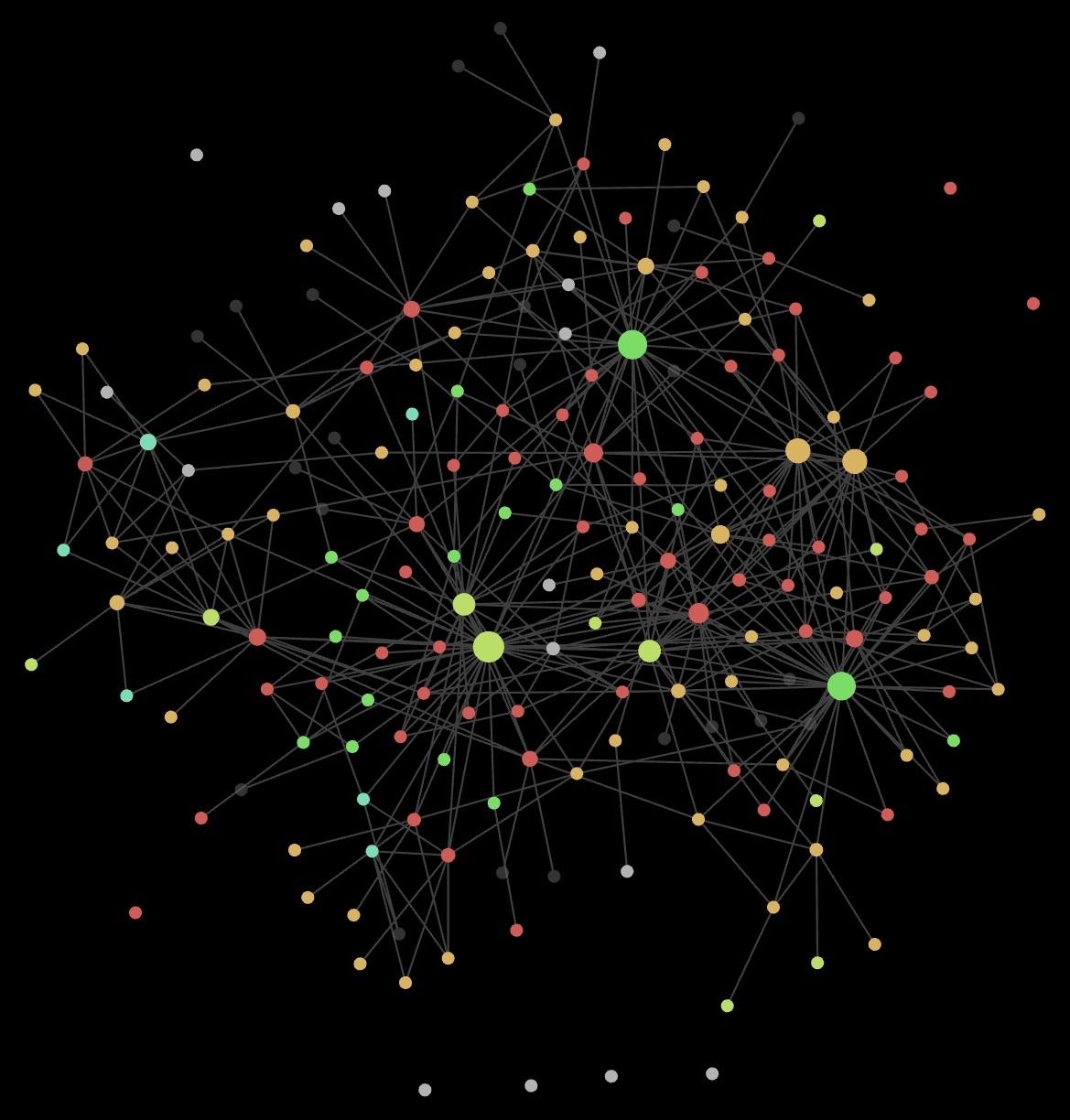
Coolest feature of Obsidian<sup id="fnref:features" role="doc-noteref"><a href="#fn:features" class="footnote" rel="footnote">5</a></sup> is the built-in <em>graph-view</em> which displays all your files and draws the references you made within them as connections.
So here you can see what my life looked like during the past couple of months:</p>

<p><a href="/assets/images/obsidian-graph.jpeg" target="_blank">
  <img src="/assets/images/obsidian-graph.webp" alt="" loading="lazy" />
</a></p>

<p>In that graph, the colours represent the folder each respective file is in.
I’ll explain it a bit:
<span class="hl-red">Red</span> are the diary entries – as you can see, there are less points than days since September, as I’ve skipped quite a few.
Still, the files are named like <code class="language-plaintext highlighter-rouge">2024-03-14.md</code>, just as you would start a new page and place a heading in a “standard” diary notebook.
In that entry, I can link to other files.
Say I want to mention London as a city I visited; then I would simply type <code class="language-plaintext highlighter-rouge">[[London]]</code> and it would automatically link to the file <code class="language-plaintext highlighter-rouge">London.md</code> which can be placed elsewhere and also contain similar links.
The size of the points represent how many of such connections there are to other files.</p>

<p>Cities are shown in <span class="hl-lime">lime</span>.
The largest point is the city I live in, and right next to it is where my family is at home.
During the winter and christmas holiday, I was there for a few weeks.
Locations are <span class="hl-green">green</span>.
Those can be many things for me, like districts or streets in a city, buildings, parks, or other places you can visit.
In the lower right corner is my university for example and the other large point at the top is where I work.</p>

<p>Now, the most interesting part (for me):
<span class="hl-orange">Orange</span> points represent people.
They are mostly people I’ve actually met on a day, but I’ve also added a few which I spend some time with – through their book which I’ve read, for example.
The two large ones on the right are close friends that also visit my university and coincidentally work at the same place.
So we naturally spend a lot of time together and I mention them pretty often in my daily entries.
The slightly separated cluster you can see on the far left comes from people of the local photography community.
We have met a few times on the street or in gallery exhibitions (such events are <span class="hl-blue">blue</span>, by the way).
I wish to see them more often though as those activities are not only fun and relaxing but evidently, as you can see by the visible separation from the rest, let me escape the everyday chaos.</p>

<p>I think this graph view is a really nice way to visualise what I do, where I do it and with whom.
This is probably just the start – imagine looking at 10 years worth of interconnections!</p>

<p>So there we have it.
I hope you have it as well, the nice time to live in and appreciate and if not, maybe read a little book to cheer you up.
The world is shit and unfair, but remember, we can shape it.</p>

<hr data-content="footnotes" />

<style>
.hl-red, .hl-lime, .hl-green, .hl-orange, .hl-blue {
  text-decoration: underline;
  text-decoration-color: #e05252;
  text-decoration-thickness: 0.25em;
  text-decoration-skip-ink: none;
}

.hl-red, .fire-opal {
  text-decoration-color: #e05252;
}

.hl-lime, .june-bud {
  text-decoration-color: #b1e052;
}

.hl-green, .UFO-green {
  text-decoration-color: #52e052;
}

.hl-orange, .sunray {
  text-decoration-color: #e0b152;
}

.hl-blue, .eucalyptus {
  text-decoration-color: #52e0b1;
}
</style>

<div class="footnotes" role="doc-endnotes">
  <ol>
    <li id="fn:tihylttw" role="doc-endnote">
      <p><a href="https://www.goodreads.com/book/show/46132305-this-is-how-you-lose-the-time-war">Goodreads page</a> of “This is How You Lose the Time War”. <a href="#fnref:tihylttw" class="reversefootnote" role="doc-backlink">&#8617;</a></p>
    </li>
    <li id="fn:sentence" role="doc-endnote">
      <p>One of my favourite sections is probably this: <em>“Flowers grow far away on a planet they’ll call Cephalus, and these flowers bloom once a century, when the living star and its black-hole enter conjunction. I want to fix you a bouquet of them, gathered across eight hundred thousand years, so you can draw our whole engagement in a single breath, all the ages we’ve shaped together.”</em> Even as I’m copying this from the book right now, my tears are knocking on the door again. <a href="#fnref:sentence" class="reversefootnote" role="doc-backlink">&#8617;</a></p>
    </li>
    <li id="fn:emmas-review" role="doc-endnote">
      <p><a href="https://emmareadstoomuch.wordpress.com/2021/01/22/the-best-books-of-the-worst-year/#:~:text=I%20tried%20to%20trick%20myself%20into%20stating%20all%20the%20ways%20in%20which%20it%20is%20amazing%2C%20but%20as%20always%20I%20got%20overwhelmed%20and%20ran%20out%20of%20words%20to%20describe%20it.">Emma’s review</a> of the book. <a href="#fnref:emmas-review" class="reversefootnote" role="doc-backlink">&#8617;</a></p>
    </li>
    <li id="fn:note-app" role="doc-endnote">
      <p>It’s weird and probably personal to me. Whenever I find a new and innovative app for taking notes, I initially like it, but eventually forget about it again. In order to actually use it over a long time, the solution needs to be so omnipresent, straigtforward and simple, that it becomes natural to remember where you noted something. I sometimes have a slight feeling that I wanted to remind myself of something, wanted to check someting later again or use a specific value for something. My current solution is Apple’s note app where I don’t organise anything and have literally just two files. One as a grocery shopping list where I keep all entries and just tick-on when I just bought it or tick-off when I used it up and need it again. And a second one for everything else. It’s a crazy mess, but the only way that works for me. Everything else I’ve tried does not, and so for the stupid reason that I simply forget that the note file even exists. I would need an additional catalogue to find where I noted what, but when noting where I noted something, I could just as well note it directly there – and that’s what I do in the one messy file. I hope it makes sense what I just wrote. Nevertheless, Obsidian somewhat sneaked into this and proved to work for me to a degree. Definitely not for the purpose I use Apple notes, but for a more meta note- and idea-keeping system. It didn’t replace anything for me, but rather provides an additional way of dumping my brain. <a href="#fnref:note-app" class="reversefootnote" role="doc-backlink">&#8617;</a></p>
    </li>
    <li id="fn:features" role="doc-endnote">
      <p>Obsidian has many other cool features, some achievable through community plugins and some inherited from the plain markdown format. Embedding photos easily without typing long links manually, PDFs can be embedded (it’s possible to scroll through them within the rendered markdown), even LaTeX formulas are rendered, GPX-tracks can be displayed on a map, hastags used inside the text, and the search function all work super well. Listing all backlinks that point to the current file, and the file tree structure that is flattened in the background for easily linking files without any paths make the app really solid. <a href="#fnref:features" class="reversefootnote" role="doc-backlink">&#8617;</a></p>
    </li>
  </ol>
</div>]]></content><author><name>Bob</name></author><category term="journal" /><category term="book" /><category term="science-fiction" /><category term="opinion" /><category term="studying" /><category term="visualisation" /><summary type="html"><![CDATA[Happy \(\pi\)-day again! Damn, already. And I noticed this just the day before yesterday and suddenly felt the need to finally write a blog again. There have been a lot of things happening in the meantime. It’s not that I’m a super active person doing so crazy many projects which I’m busy with all day along, but still, I didn’t find much time for myself without some kind of stress related to “things need to be finished in \(x\) days”. So here is a little wrap-up of some interesting things that happened. Nothing related to \(\pi\), unfortunately. Please enjoy Matt Parker’s video for any celebration purposes.]]></summary></entry><entry><title type="html">The Greatest Of All Symphonies</title><link href="https://codingbobby.xyz/blog/space-symphonies/" rel="alternate" type="text/html" title="The Greatest Of All Symphonies" /><published>2023-10-07T00:00:00+00:00</published><updated>2023-10-07T00:00:00+00:00</updated><id>https://codingbobby.xyz/blog/space-symphonies</id><content type="html" xml:base="https://codingbobby.xyz/blog/space-symphonies/"><![CDATA[<p>Perhaps the most beautiful thing I’ve read in fiction was in Chasm City by Alastair Reynolds<sup id="fnref:the-book" role="doc-noteref"><a href="#fn:the-book" class="footnote" rel="footnote">1</a></sup>.
I finished reading it in July this year, but I am still thinking about it pretty often.
It is only a side story of a person called <em>Quirrenbach</em>, the main character <em>Mirabel</em> met on a short travel in a shuttle from the main lightship to a space station.
They stayed together until after transitioning down to the planet but <em>Mirabel</em> wasn’t even interested in <em>Quirrenbach</em>’s story or company as he had another job to do.</p>

<p><em>Quirrenbach</em> introduced himself as a music composer who has put himself into cryosleep and travelled many lightyears across solar systems to visit this legendary planet called Yellowstone to compose a symphony about it’s glamourous utopia he was told about.
When he finally arrives, he finds a planetary system rotten by an alien virus that infected all materials containing advanced nanotechnology.
It transformed the entire city into a swollen chaotic metal-organic jungle with a completely broken society and only primitive, mostly mechanical technology from an age long ago.
<em>Quirrenbach</em> is shocked and worried what to do but then figures he must continue and now create a tragical piece from what he discovered.</p>

<p>This is told to <em>Mirabel</em> on the go and not elaborated in more detail, but thinking about it and imagining the grand scale of his musical masterpiece he so deeply must have dreamed about and now vanished into nothing is so breathtaking for me.
If ever we as humans travel deep space, and a composer that devotes his entire life into capturing the beauty of planets and stars as musical pieces, it will be the single most beautiful thing so astonishing that we can’t possibly imagine it yet.</p>

<p>I belive that music and only music is powerful enough to accomplish this. Even though I am strongly influenced by Ansel Adam’s quote, I think on a scale greater than us individual beings, silence, and even photographs are not adequate.</p>

<blockquote>
  <p>When words become unclear, I shall focus with photographs.
When images become inadequate, I shall be content with silence.</p>

  <p><span class="align-right">– Ansel Adams</span>
<br /></p>

  <p>But if stars and planets are the abouts, silence shall be filled with melody.</p>

  <p><span class="align-right">– extended by me</span></p>
</blockquote>

<p>If you want to get a sense of what is possible with music, you should listen to the compositions by James Paget<sup id="fnref:paget" role="doc-noteref"><a href="#fn:paget" class="footnote" rel="footnote">2</a></sup> or Keith Merrill<sup id="fnref:merrill" role="doc-noteref"><a href="#fn:merrill" class="footnote" rel="footnote">3</a></sup>, Thomas Bergersen’s Humanity project<sup id="fnref:bergersen" role="doc-noteref"><a href="#fn:bergersen" class="footnote" rel="footnote">4</a></sup> and Neurotech’s cyber-industrial metal<sup id="fnref:neurotech" role="doc-noteref"><a href="#fn:neurotech" class="footnote" rel="footnote">5</a></sup>. Those, I think, are the closest you get to what <em>Quirrenbach</em> was about to create.</p>

<p>For the sake of completeness, I should add the following:</p>

<details>
  <summary>Click to reveal (light) Spoilers</summary>
  <i>
  Quirrenbach reappears very late in the book, and it turns out that he is not who he told Mirabel he was, and was in fact working for the enemy.
  Although the story about him being a composer still holds true.
  At first he ignores the question about the state of his symphony but later simply adds that it is progressing splendidly.
  Sadly, the topic is not further talked about—I think it would have made a great side story.
  </i>
</details>

<p>Apart from all this, I found <em>Chasm City</em> to be among the greatest novellas I have read.
It’s a very personal story taking place in a universe that is—well an entire universe.
Reynold’s <em>Revelation Space</em> books have such a scale and are yet filled with so many senseful and raw details forming a complete histroy<sup id="fnref:timeline" role="doc-noteref"><a href="#fn:timeline" class="footnote" rel="footnote">6</a></sup> of humanity’s future before your eyes that it is hard to believe it was creatively created.
Contrary to the dystopian and brutal nature of this imagination, I somehow hope it will become true.</p>

<hr data-content="footnotes" />

<div class="footnotes" role="doc-endnotes">
  <ol>
    <li id="fn:the-book" role="doc-endnote">
      <p><a href="https://www.goodreads.com/book/show/89185.Chasm_City">Chasm City</a> by <a href="https://www.alastairreynolds.com/">Alastair Reynolds</a>. If you’re interested and want to read it, I highly recommend that you start with the first part of the series, <a href="https://www.goodreads.com/book/show/89187.Revelation_Space">Revelation Space</a>. You’re going to be hooked! <a href="#fnref:the-book" class="reversefootnote" role="doc-backlink">&#8617;</a></p>
    </li>
    <li id="fn:paget" role="doc-endnote">
      <p>James Paget on <a href="https://jamespaget.bandcamp.com/">bandcamp</a>; <a href="https://jamespaget.bandcamp.com/album/the-wonder-of-gaia">The Wonder of Gaia</a> is particularly beautiful. <a href="#fnref:paget" class="reversefootnote" role="doc-backlink">&#8617;</a></p>
    </li>
    <li id="fn:merrill" role="doc-endnote">
      <p><a href="https://soundcloud.com/keithmerrill/sets/album-awakening">Awakening</a> and <a href="https://soundcloud.com/keithmerrill/sets/album-inspiration">Inspiration</a> by <a href="http://keithmerrillmusic.com/">Keith Merrill</a> are breathtaking. <a href="#fnref:merrill" class="reversefootnote" role="doc-backlink">&#8617;</a></p>
    </li>
    <li id="fn:bergersen" role="doc-endnote">
      <p><a href="https://www.thomasbergersen.com/humanity/">Humanity</a> by Thomas Bergersen is a series of seven albums that is still in the writing, one through five are already released. <a href="#fnref:bergersen" class="reversefootnote" role="doc-backlink">&#8617;</a></p>
    </li>
    <li id="fn:neurotech" role="doc-endnote">
      <p>Particularly <a href="https://neurotech.bandcamp.com/album/in-remission">In Remission</a> or <a href="https://neurotech.bandcamp.com/album/symphonies">Symphonies</a> by <a href="https://neurotech.bandcamp.com/music">Neurotech</a>. <a href="#fnref:neurotech" class="reversefootnote" role="doc-backlink">&#8617;</a></p>
    </li>
    <li id="fn:timeline" role="doc-endnote">
      <p>A <a href="https://www.alastairreynolds.com/rs-universe/revelation-space-universe-timeline/">timeline</a> of the major events in “Revelation Space”. <a href="#fnref:timeline" class="reversefootnote" role="doc-backlink">&#8617;</a></p>
    </li>
  </ol>
</div>]]></content><author><name>Bob</name></author><category term="music" /><category term="book" /><category term="science-fiction" /><category term="opinion" /><summary type="html"><![CDATA[Perhaps the most beautiful thing I’ve read in fiction was in Chasm City by Alastair Reynolds1. I finished reading it in July this year, but I am still thinking about it pretty often. It is only a side story of a person called Quirrenbach, the main character Mirabel met on a short travel in a shuttle from the main lightship to a space station. They stayed together until after transitioning down to the planet but Mirabel wasn’t even interested in Quirrenbach’s story or company as he had another job to do. Chasm City by Alastair Reynolds. If you’re interested and want to read it, I highly recommend that you start with the first part of the series, Revelation Space. You’re going to be hooked! &#8617;]]></summary></entry><entry><title type="html">The 19 Sprott Attractors</title><link href="https://codingbobby.xyz/blog/all-sprott-attractors/" rel="alternate" type="text/html" title="The 19 Sprott Attractors" /><published>2022-10-12T00:00:00+00:00</published><updated>2022-10-12T00:00:00+00:00</updated><id>https://codingbobby.xyz/blog/all-sprott-attractors</id><content type="html" xml:base="https://codingbobby.xyz/blog/all-sprott-attractors/"><![CDATA[<p>Big news everyone!
I now have my own online shop.
Wait, whoa, how did that happen?</p>

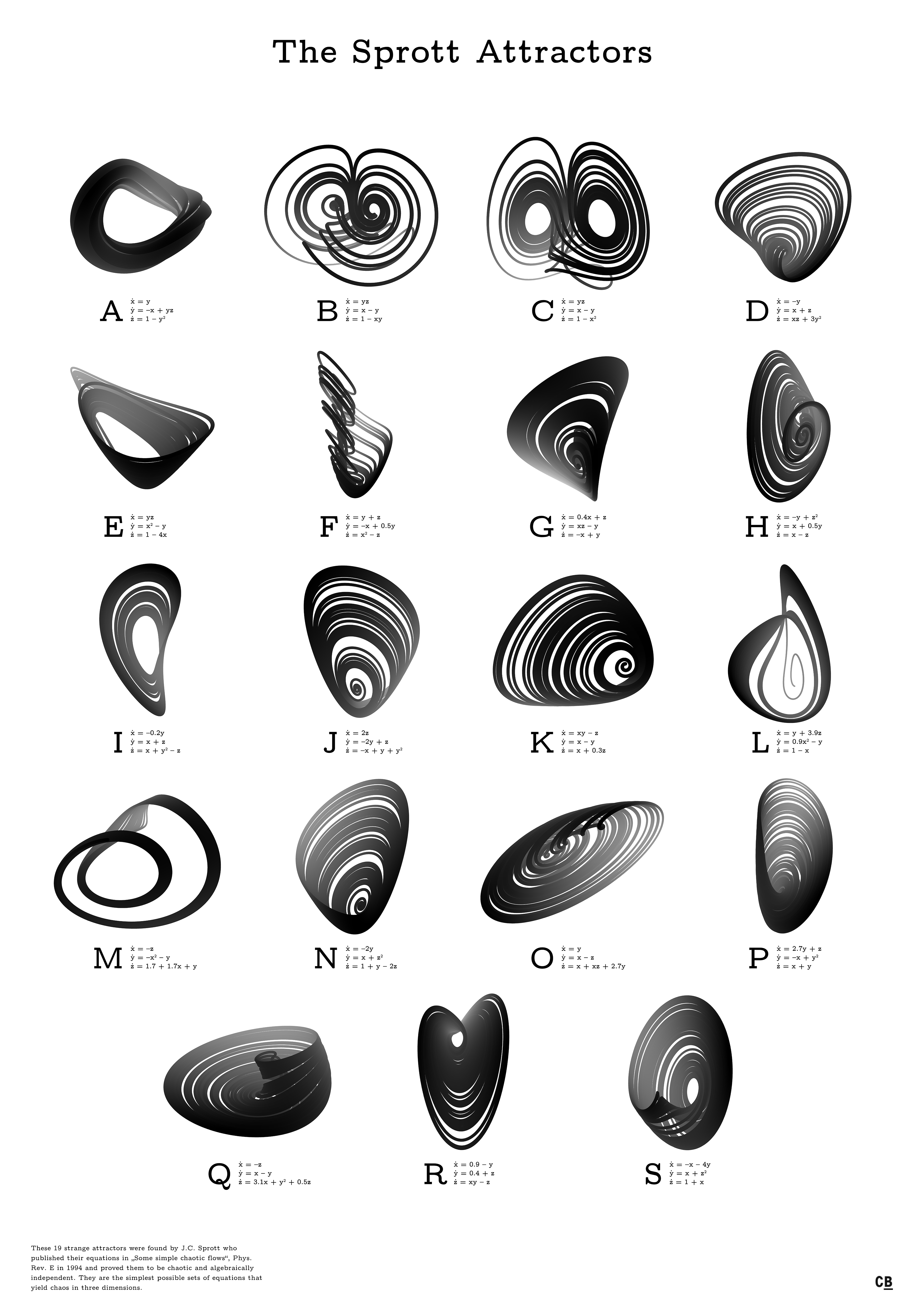
<p>Well, I’ve done experiments the other day – again, with renders of strange attractors – and I focussed on those found by J.C. Sprott in 1994.
He discovered 19 distinct cases of the most simple chaotic attractors possible, some of which I have rendered artistically <a href="/projects/chaotic-shapes">here</a>.</p>

<p>Because Sprott’s work is pretty significant, I wondered why I couldn’t find much resources about them online, comparisons of the attractor’s features for example.
Obviously, there has been done extensive scientific research on the systems (more than 800 articles cite the original publication), but even among those that do direct analysis most of the times do it on only one or two of Sprott’s cases.
I wanted to change that, though, as I am no mathematician, my approach to this is not to look at the formulas, but at the visuals.</p>

<p><a href="/assets/images/attractors/sprott-a-02.png" target="_blank">
  <img src="/assets/images/attractors/sprott-a-02.webp" loading="lazy" alt="The Sprott-A Attractor" style="width: 80%" />
</a></p>

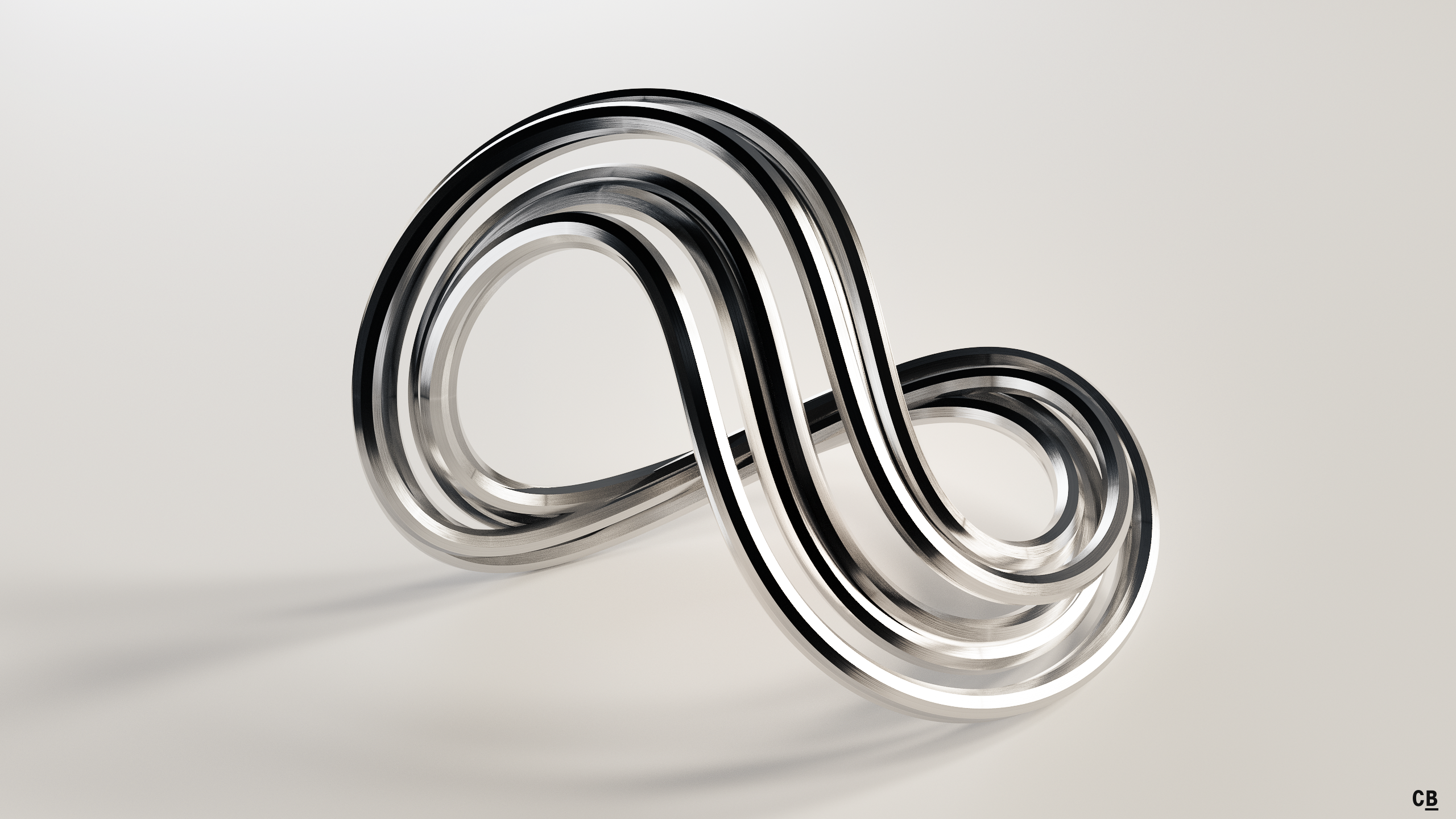
<p>Until now, I only had time to take a look at the cases <a href="/projects/chaotic-shapes/sprott-a">A</a>, <a href="/projects/chaotic-shapes/sprott-d">D</a>, and <a href="/projects/chaotic-shapes/sprott-g">G</a>; and afterwards, I came up with a simple but very elegant way of rendering 3D attractors with only a line that still gets a three dimensional look by varying the line’s thickness and brightness<sup id="fnref:render-technique" role="doc-noteref"><a href="#fn:render-technique" class="footnote" rel="footnote">1</a></sup>.
You can find that technique used in stereographic animations I show beneath the usual renders and in my past blog post <a href="../stereographic-animations">here</a>.
I now improved it a bit and created still images of <em>all</em> of those 19 Sprott attractors.</p>

<p>And here is the collage I made with them:</p>

<p><a href="/assets/images/attractors/sprott-attractors.png" target="_blank">
  <img src="/assets/images/attractors/sprott-attractors-small.png" loading="lazy" alt="The Sprott Attractors" style="width: 60%" />
</a></p>

<p>Since I have printed the Nosé-Hoover attractor <a href="../printing-digital-art">back in the day</a> for my own wall, I have thought about offering something to you dear readers.
As I explained, I find it a pity that nowadays almost all digital images will only accumulate virtual dust, never become physical – and I want to change that not only for myself, but also for you, who will definitely enjoy the beautiful chaos of the attractors even more when it is printed on actual paper.</p>

<p>So, here it is, with oh-so many products, my shop:</p>

<p class="rainbow-text"><a href="https://shop.codingbobby.xyz" target="_blank">
  shop.codingbobby.xyz
</a></p>

<p>PS: If the poster is a little too much for you, I have also made postcards from some of the Sprott cases, which I’d be happy to send you in return for a small donation.</p>

<style>
.rainbow-text {
	font-size: 2.5rem;
  text-align: center;
}
.rainbow-text:hover a {
  text-decoration: none;
}

.rainbow-text:hover {
	background: linear-gradient(to right, violet, indigo, blue, green, yellow, orange, red);
	background-size: 300%;
  
	-webkit-background-clip: text;
	-webkit-text-fill-color: transparent;
	animation: animated_text 10s ease-in-out infinite;
	-moz-animation: animated_text 10s ease-in-out infinite;
	-webkit-animation: animated_text 10s ease-in-out infinite;
}

@keyframes animated_text {
	0% { background-position: 0px 50%; }
	50% { background-position: 100% 50%; }
	100% { background-position: 0px 50%; }
}
</style>

<hr data-content="footnotes" />

<div class="footnotes" role="doc-endnotes">
  <ol>
    <li id="fn:render-technique" role="doc-endnote">
      <p>The wallpaper-style renders I have done before do reward you with a realistic look and great detail, but adjusting attractor model, design the set around it, model supporting objects and fine-tune materials and the lighting setup takes a lot of time – not to mention the actual time it takes to ray-trace the scene during rendering. No doubt, I will continue creating these, but for this project, showing the raw attractors with a look free from any distractions worked perfectly. The “Rendering” I’m doing here is really quick and I only have to adjust parameters like orientation, simulation speed and framing when moving to a new attractor system. <a href="#fnref:render-technique" class="reversefootnote" role="doc-backlink">&#8617;</a></p>
    </li>
  </ol>
</div>]]></content><author><name>Bob</name></author><category term="journal" /><category term="visualisation" /><category term="mathematics" /><summary type="html"><![CDATA[Big news everyone! I now have my own online shop. Wait, whoa, how did that happen?]]></summary></entry><entry><title type="html">Browser Black Magic</title><link href="https://codingbobby.xyz/blog/browser-black-magic/" rel="alternate" type="text/html" title="Browser Black Magic" /><published>2022-08-28T00:00:00+00:00</published><updated>2022-08-28T00:00:00+00:00</updated><id>https://codingbobby.xyz/blog/browser-black-magic</id><content type="html" xml:base="https://codingbobby.xyz/blog/browser-black-magic/"><![CDATA[<p>As you might know, I hate Google, and I want to remove it from my life as much as I can.
So let’s talk about browsers.
Chrome is not an option and even if Chromium is fully de-googled, I’m still never going to use it.
Why? It <em>reminds</em> me of Google.</p>

<p>I understand that a basic product which wants to achieve wide accessibility has to have a consistent UI that never changes much and has to be as flat as possible without any niche functions not everybody would use frequently – because those would distract and confuse.
But keeping the UI as plain as possible results in a boring appearance and a very dull feeling when using it.
That’s what I dislike so much about Material Design by Google.
It is so much optimised to work in every use case that it is by far the worst set of icons, colours, button designs and UI elements I have seen yet.
I would rather use a desktop designed like macOS X Cheetah than one that follows the Material Design guidelines.</p>

<p>And Chromium is also such a product that is so hardly optimised for everyone that it is very badly optimised for each individual user.</p>

<p>But I’m not grandma Dorothea who never used anything else than Chrome (installed by her grandson who studies computer science which she misinterpreted as service technician) and when suddenly a second tab opened, she is screwed and doesn’t know how to navigate anymore because it now looks slightly different.
I’m not somebody who doesn’t know how to use a computer.<sup id="fnref:use-computers" role="doc-noteref"><a href="#fn:use-computers" class="footnote" rel="footnote">1</a></sup></p>

<p>Now, what works better for me?</p>
<ul>
  <li>Firefox.
It doesn’t eat your memory as much, and I very much like the way Mozilla does things.
For example, their extensive documentations for web developers that even cover products by Google for which Google itself does not provide any documentation.</li>
  <li>Vivaldi.
Very customisable by default, and I can move the tabs on the left side with a simple setting.
But it’s based on Chromium, so it’s also memory-hungry.</li>
  <li>Arc.
A new hyped browser that claims to create a brand-new experience because it does everything different.
But it actually doesn’t, because it’s also based on chromium like everything else and just puts a fancy macOS design on it.
The tab list is great and the shortcuts and commands as well, but why the hell does it shrink the URL field to such miniscule widths?
Like, if you never want to see the path you are visiting?</li>
</ul>

<p>I tried many things, but in the end stuck to the good old Firefox, which I modified so heavily that it neither looks, nor feels like Firefox.
It’s so different from anything else that probably nobody else knows how use it.
But nobody else has to.</p>

<p>And because I looked at every single component to find out how I could modify it to make it better, I know exactly how it functions, and only that matters.
Because of that, I also don’t have to write down how it works and since it’s my computer, I don’t have to explain it to anybody.
Although I’m doing precisely that right here.</p>

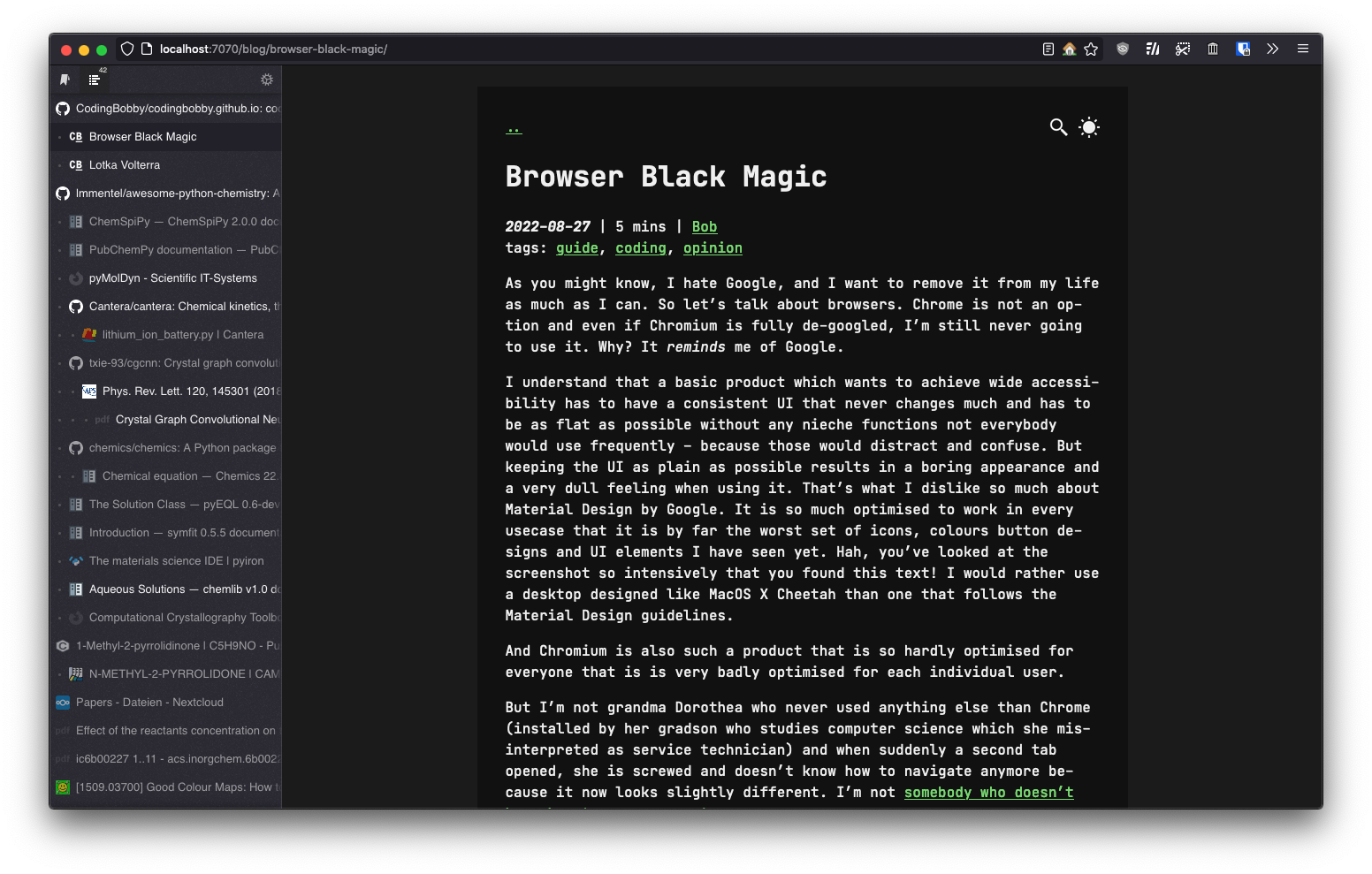
<p>So, this is how my Firefox looks like:</p>

<p><img src="/assets/images/screenshot-firefox.png" alt="Transformed Pixels" width="100%" /></p>

<p>What you’ll find is that the tabs are on the left and in a vertical list, that they group into a tree structure, that there are no close buttons, no scrollbar, not even a button for opening a new tab.
In the address bar, there is no reload button, no back and forward buttons, no bookmarks, no title bar, no row of several extension icons.</p>

<p>But I can still access all of those functionalities I have hidden from the UI:
The tab close buttons are hidden on the favicon.
I can click the icon of any tab, and it closes.
No need to scroll in a horizontal row until I find it, open it so that the website loads and reveals the close button on the right of the tab.
I don’t need a scrollbar, because I know it’s a scrollable list.
New tabs can be created with <strong>⌘+T</strong>; I have always done it that way and don’t need a button for it.
Tweaking some settings also places the newly opened tab next to the currently active and not 68 tabs farther down the list.</p>

<p>Same with reloading, which can be done with <strong>⌘+R</strong> and back and forward navigation, which I do with the mouse gesture or <strong>⌘+⮂</strong> and  <strong>⌘+⮀</strong>.
Bookmarks are in the tab list as a second page.
This makes way more sense to only use them there as there is already a sidebar that occupies space and doesn’t open a new one which causes layout shifts etc.
But most times I don’t even need to open the bookmarks list, as the address bar already searches through them.</p>

<p>Speaking of the address bar, the font size of the URL is also reduced to fit even more of it.
Most extensions I have installed are passive, and they can rest in the overflow menu.
Removing all the unnecessary buttons from the address bar makes it possible to display far longer URLs than what’s possible in other browsers (especially Arc) and keep the profile very thin at the same time.
Inside the list of search results, Firefox always shows a section with icons for other search engines and an entry to search with the second most used engine.
I removed those, as well as the prompt to log in for account synchronisation you’ll find in the burger menu.</p>

<p>As the tab side bar is collapsible with a shortcut (set it to <strong>^+⌥+B</strong>) and the remaining UI is only the minimal address bar and a very large area for the website, I don’t even need to go into full-screen mode anymore when I watch films or streams.
Also, the tree structure is produced when opening links from one page that open in a new background tab.
I almost always do that by holding <strong>⌘</strong> when clicking a link.
Tabs can also moved into groups manually.</p>

<p>So how have I done it?</p>

<h3 id="enable-compact-mode">enable compact mode</h3>
<p>Follow <a href="https://support.mozilla.org/en-US/kb/compact-mode-workaround-firefox">this guide</a> to reduce the height of the default tab bar by enabling compact mode.</p>

<h3 id="install-sidebery-extension">install Sidebery extension</h3>
<p>The sidebar listing the tabs comes from <a href="https://github.com/mbnuqw/sidebery">Sidebery</a>.
It has a massive amount of settings that are actually useful and worth to fully search through.
If you want to start with <a href="https://gist.github.com/CodingBobby/4a953c5c2e4709247d1b9b7a51e8d09f">my settings</a>, you can import them below the <em>help</em> section in Sidebery’s settings.
Customising the looks of it is easy to do with the provided <em>styles editor</em>.
This is the CSS I added:
<script src="https://gist.github.com/CodingBobby/3ba7714de8e94af056579a8c3d3e87b4.js"></script></p>

<h3 id="enable-userchromecss">enable userChrome.css</h3>
<p>In order to modify the CSS of the browser itself, the stylesheet <code class="language-plaintext highlighter-rouge">userChrome.css</code> has to be read by Firefox<sup id="fnref:breaking-changes" role="doc-noteref"><a href="#fn:breaking-changes" class="footnote" rel="footnote">2</a></sup>.
To enable it, navigate to <code class="language-plaintext highlighter-rouge">about:config</code> (enter it into the address bar) and search for the setting <code class="language-plaintext highlighter-rouge">toolkit.legacyUserProfileCustomizations.stylesheets</code> (copy that into the search field).
Double click onto the resulting setting element to set its state from <code class="language-plaintext highlighter-rouge">false</code> to <code class="language-plaintext highlighter-rouge">true</code>.
Now, find the location for the CSS file; on macOS, at <code class="language-plaintext highlighter-rouge">~/Library/Application Support/Firefox/Profiles/</code> there are several folders starting with a random ID, followed with the user profile.
You should move into the one ending in <code class="language-plaintext highlighter-rouge">.default-release</code> and create a new folder named <code class="language-plaintext highlighter-rouge">chrome</code> if not present already.
Inside there you can finally create the file <code class="language-plaintext highlighter-rouge">userChrome.css</code> and enter your custom code<sup id="fnref:custom-css" role="doc-noteref"><a href="#fn:custom-css" class="footnote" rel="footnote">3</a></sup>.
Changes do not apply in real-time and you have to restart Firefox to apply the changes.
Mine is this:
<script src="https://gist.github.com/CodingBobby/1db38a9b90e1bc41bab302017ecd3cc2.js"></script></p>

<h3 id="tweak-other-settings">tweak other settings</h3>
<p>The arrangement and visibility of the other buttons in the new toolbar can be dragged and removed after you right click on the bar and go to <em>customise menu</em> (where you have previously chosen compact mode).
I removed everything except the screenshot button (because I otherwise forget that Firefox has its own screenshot tool) and very few extensions I often want to look at or click on.</p>

<p>And that’s it!
I now have the perfect browser that protects my privacy far more than any default browser would<sup id="fnref:extensions" role="doc-noteref"><a href="#fn:extensions" class="footnote" rel="footnote">4</a></sup>, has the most space efficient UI out there, and can only be used by myself (and you, who read this).
Believe me, it’s a far greater experience to surf and research now.
Maybe, this little guide helps you to realise, that browsers don’t have to be the most boring piece of software you’re using every day, that you don’t have to throw your private data at Google just to browse the internet, and that you don’t have to fear to customise your computer to an extend that would confuse other people.
Go ahead, and figure out how to make your browser better!</p>

<hr data-content="footnotes" />

<div class="footnotes" role="doc-endnotes">
  <ol>
    <li id="fn:use-computers" role="doc-endnote">
      <p><a href="http://coding2learn.org/blog/2013/07/29/kids-cant-use-computers">This</a> blog from over 9 years ago will never loose relevance. <a href="#fnref:use-computers" class="reversefootnote" role="doc-backlink">&#8617;</a></p>
    </li>
    <li id="fn:breaking-changes" role="doc-endnote">
      <p>You might argue that Firefox is in active development and CSS selectors and other functionalities likely change in the future and break your modified version. Yes, that will totally happen. But as it is only one CSS file I can simply rename to let it be ignored by Firefox and the tab sidebar is only an extension I can deactivate, it is very quick to get back to the default browser. <a href="#fnref:breaking-changes" class="reversefootnote" role="doc-backlink">&#8617;</a></p>
    </li>
    <li id="fn:custom-css" role="doc-endnote">
      <p><a href="https://github.com/piroor/treestyletab/wiki/Code-snippets-for-custom-style-rules">Here</a> is a very extensive list of things you can do with <code class="language-plaintext highlighter-rouge">userChrome.css</code> and other hidden tweaks. <a href="#fnref:custom-css" class="reversefootnote" role="doc-backlink">&#8617;</a></p>
    </li>
    <li id="fn:extensions" role="doc-endnote">
      <p>Thanks to the extensions <a href="https://privacybadger.org/">Privacy Badger</a>, <a href="https://decentraleyes.org/">Decentraleyes</a>, <a href="https://addons.mozilla.org/de/firefox/addon/neat-url/">NeatURL</a>, <a href="https://github.com/gorhill/uBlock#ublock-origin">uBlock Origin</a> and <a href="https://addons.mozilla.org/de/firefox/addon/requestcontrol/">Request Control</a>. <a href="#fnref:extensions" class="reversefootnote" role="doc-backlink">&#8617;</a></p>
    </li>
  </ol>
</div>]]></content><author><name>Bob</name></author><category term="guide" /><category term="coding" /><category term="opinion" /><summary type="html"><![CDATA[As you might know, I hate Google, and I want to remove it from my life as much as I can. So let’s talk about browsers. Chrome is not an option and even if Chromium is fully de-googled, I’m still never going to use it. Why? It reminds me of Google.]]></summary></entry><entry><title type="html">Books about Chaos and Fractals</title><link href="https://codingbobby.xyz/blog/chaotic-books/" rel="alternate" type="text/html" title="Books about Chaos and Fractals" /><published>2022-05-18T00:00:00+00:00</published><updated>2022-05-18T00:00:00+00:00</updated><id>https://codingbobby.xyz/blog/chaotic-books</id><content type="html" xml:base="https://codingbobby.xyz/blog/chaotic-books/"><![CDATA[<p>In the past few weeks, I unfortunately didn’t find much time to write more for my blog.
So today, I have a simple list of awesome books I have in my shelf and found particularly helpful on my journey through chaos theory.
If you are on a similar trip, they will definitely teach you a bit more than the typical Wikipedia article.</p>

<p>I have categorised them roughly:</p>

<ol>
  <li><a href="#popular-science-books">Popular-Science</a></li>
  <li><a href="#computer-science-oriented-books">Computer-Science</a></li>
  <li><a href="#academic-literature">Academic Literature</a></li>
  <li><a href="#picture-books">Picture Books</a></li>
</ol>

<p>If you find any book missing in this list, please share it in the comments!</p>

<h2 id="popular-science-books">Popular-Science Books</h2>

<h3 id="chaos-by-j-gleick-1987"><a href="https://www.goodreads.com/book/show/64582.Chaos"><em>Chaos</em></a> by J. Gleick (1987)</h3>
<p><img src="https://i.gr-assets.com/images/S/compressed.photo.goodreads.com/books/1327941595l/64582.jpg" alt="" />
A very good historical summary of what it took to discover chaos, study chaos and explain chaos.
In <em>Chaos</em>, James Gleick not only describes what happened back then, but lets you discover the simply mind-boggling science yourself.</p>

<h3 id="sync-by-s-strogatz-2003"><a href="https://www.goodreads.com/book/show/354421.Sync"><em>Sync</em></a> by S. Strogatz (2003)</h3>
<p><img src="https://i.gr-assets.com/images/S/compressed.photo.goodreads.com/books/1391275634l/20686518.jpg" alt="" />
Steven Strogatz is an exceptionally good lecturer at Cornell University as well as a very good writer that explains strange and complex concepts to you like not many other people can do.
This book goes a step beyond “simple” chaos and shows you how nature manages to synchronise its elemental randomness back into order.</p>

<h2 id="computer-science-oriented-books">Computer-Science oriented Books</h2>

<h3 id="cpcb-by-c-pickover-1990"><a href="https://www.goodreads.com/book/show/1920189.Computers_Pattern_Chaos_and_Beauty"><em>CPCB</em></a> by C. Pickover (1990)</h3>
<p><img src="https://i.gr-assets.com/images/S/compressed.photo.goodreads.com/books/1519419991l/1920189._SX318_.jpg" alt="" />
<em>Computers, Pattern, Chaos and Beauty</em> is my favourite of these books.
It inspired me to write my own little programs to compute fractal images and attractors renders, which you can also find <a href="/projects/chaotic-shapes">on my website</a>.
Cliff Pickover covers a lot of rather untypical topics and tells more about their mathematical background, but also provides some useful pseudocode algorithms.</p>

<h3 id="the-science-of-fractal-images-by-peitgen-et-al-1988"><a href="https://www.goodreads.com/book/show/384936.The_Science_of_Fractal_Images"><em>The Science of Fractal Images</em></a> by Peitgen et al. (1988)</h3>
<p><img src="https://i.gr-assets.com/images/S/compressed.photo.goodreads.com/books/1387737779l/384936.jpg" alt="" />
Detailed and highly in-depth descriptions of fractal rendering methods and algorithms.
Eight specialized researchers bring together their knowledge about all important aspects of the simulation and modelling of fractal growth, generation of random as well as deterministic fractals and patterns and show how to create digital representations of nature based on the science of fractals.
Many pseudocodes are included.</p>

<h3 id="strange-attractors-by-jc-sprott-1993"><a href="https://www.goodreads.com/book/show/353884.Strange_Attractors"><em>Strange Attractors</em></a> by J.C. Sprott (1993)</h3>
<p><img src="https://i.gr-assets.com/images/S/compressed.photo.goodreads.com/books/1415553369l/353884.jpg" alt="" />
This could also be included in the <a href="#picture-books">Picture Books</a> section, because this book contains a large collection of renders of two- and more-dimensional strange attractors.
But in addition to that, each model is explained in great detail and BASIC program codes are provided you can run on your own PC.
Although, this book and its programs are old, one can learn a lot of computer-science and 
mathematics from them.</p>

<h2 id="academic-literature">Academic Literature</h2>

<h3 id="introduction-to-dynamical-systems-by-brin-and-stuck-2002"><a href="https://www.goodreads.com/book/show/410673.Introduction_to_Dynamical_Systems"><em>Introduction to Dynamical Systems</em></a> by Brin and Stuck (2002)</h3>
<p><img src="https://i.gr-assets.com/images/S/compressed.photo.goodreads.com/books/1348838639l/410673.jpg" alt="" />
Relatively little focus on chaos theory itself, but a great support for understanding how a system becomes dynamic and what types of systems there are scattered across different fields of mathematics.
This basic knowledge helps to understand more advanced theories discussed in more specialised 
books.</p>

<h3 id="chaos-and-fractals-by-peitgen-saupe-and-jürgens-1992"><a href="https://www.goodreads.com/book/show/371438.Chaos_and_Fractals"><em>Chaos and Fractals</em></a> by Peitgen, Saupe and Jürgens (1992)</h3>
<p><img src="https://i.gr-assets.com/images/S/compressed.photo.goodreads.com/books/1347705948l/371438.jpg" alt="" />
In my opinion, the standard work in this field.
With this, you get over 800 pages of condensed knowledge about basically every aspect of chaos theory.
The beauty you’ll find in this book is not necessarily in visually appealing images, but in the mathematics of this enthralling science.</p>

<h2 id="picture-books">Picture Books</h2>

<h3 id="the-fractal-geometry-of-nature-by-b-mandelbrot-1977"><a href="https://www.goodreads.com/book/show/558059.The_Fractal_Geometry_of_Nature"><em>The Fractal Geometry of Nature</em></a> by B. Mandelbrot (1977)</h3>
<p><img src="https://i.gr-assets.com/images/S/compressed.photo.goodreads.com/books/1315596427l/558059.jpg" alt="" />
Possibly the greatest and single most important publication about fractal images and what this field in mathematics is about.
Benoît Mandelbrot himself shows every aspect of fractals he knew at the time and draws a connection between them.
Depending on the edition, this book might cost you a fortune.</p>

<h3 id="the-beauty-of-fractals-by-peitgen-and-richter-1986"><a href="https://www.goodreads.com/book/show/2205059.The_Beauty_of_Fractals"><em>The Beauty of Fractals</em></a> by Peitgen and Richter (1986)</h3>
<p><img src="https://i.gr-assets.com/images/S/compressed.photo.goodreads.com/books/1387740294l/558114.jpg" alt="" />
Actually beautiful and high-quality pictures of fractals and chaotic objects in a large-format book with great explanations of what is depicted and some theory behind it.</p>

<h3 id="the-malphath-betaook-by-c-pickover-2009"><a href="https://www.goodreads.com/book/show/6393242-the-math-book"><em>The M\(\alpha\)TH \(\beta\)OOK</em></a> by C. Pickover (2009)</h3>
<p><img src="https://i.gr-assets.com/images/S/compressed.photo.goodreads.com/books/1328768386l/6393242.jpg" alt="" />
A great timeline of important discoveries in mathematics.
From 150 Million B.C. to 2007, Cliff Pickover shows 250 milestones with a great image and provides a short summary of what it is about and why it was important.
The hardback edition is particularly nice to flip through.</p>

<style>
article p::after {
  content: '';
  clear: both;
  display: table;
}
article img {
  float: left;
  padding-right: 1em;
  max-width: 10em;
  width: 50%;
}
</style>]]></content><author><name>Bob</name></author><category term="book" /><category term="mathematics" /><category term="science" /><category term="studying" /><summary type="html"><![CDATA[In the past few weeks, I unfortunately didn’t find much time to write more for my blog. So today, I have a simple list of awesome books I have in my shelf and found particularly helpful on my journey through chaos theory. If you are on a similar trip, they will definitely teach you a bit more than the typical Wikipedia article.]]></summary></entry><entry><title type="html">Stereographic Animations</title><link href="https://codingbobby.xyz/blog/stereographic-animations/" rel="alternate" type="text/html" title="Stereographic Animations" /><published>2022-03-14T00:00:00+00:00</published><updated>2022-03-14T00:00:00+00:00</updated><id>https://codingbobby.xyz/blog/stereographic-animations</id><content type="html" xml:base="https://codingbobby.xyz/blog/stereographic-animations/"><![CDATA[<p>Happy Pi-Day everyone!
When I recently found a postcard I got from a friend some years back, I was hooked.
The front showed one of those magic-eye-autostereograms<sup id="fnref:wikipedia" role="doc-noteref"><a href="#fn:wikipedia" class="footnote" rel="footnote">1</a></sup> you might as well know.
You don’t?
Well, you have missed loads of joy!<sup id="fnref:impossible" role="doc-noteref"><a href="#fn:impossible" class="footnote" rel="footnote">2</a></sup></p>

<p>Anyway, because this year’s Pi-Day was just around the corner, I wanted to create some stereograms with \(\pi\)-inspired motifs.
But heck, creating patterns that first of all look nice and secondly fit the magic requirements turned out to be very difficult<sup id="fnref:patterns" role="doc-noteref"><a href="#fn:patterns" class="footnote" rel="footnote">3</a></sup>.
I eventually gave up on that idea (so, no Pi things this time) but I was still struck by the amazingly simple working principle of stereograms.<sup id="fnref:koeller" role="doc-noteref"><a href="#fn:koeller" class="footnote" rel="footnote">4</a></sup></p>

<p>After I clearly understood how they work and what properties work better than others, I still needed good motifs.
Those typical ones – cubes, hearts, trumpets, or similar simple objects – were too low level for my demands, especially if I don’t even have a pattern to hide them.
But then I remembered that I always wanted to get a more profound feeling of the attractors<sup id="fnref:attractor-journey" role="doc-noteref"><a href="#fn:attractor-journey" class="footnote" rel="footnote">5</a></sup>.
I calculated them, I manipulated them, I interacted with them in 3D software and I even printed large renders of them onto paper – but none of that gave me a true feeling of their three differential equations.</p>

<p>So, here I ended up creating very non-magical-looking 3D images that are two 2D images unless you perform weird eye movements.</p>

<h2 id="train-your-abilities">Train Your Abilities</h2>

<p>Here is a “training” image for you, if you are not familiar with how stereograms work:</p>

<p><img src="/assets/images/stereo-training.png" alt="training-for-stereograms" /></p>

<p>All you have to do is to look through the screen as if you focus a distant object behind it.
Make your eyes independently leave the single spot you currently look at somewhere on the screen and let them wander apart.
Imagine firing lasers from your eyes, but those lasers have to shoot parallel to each other and not cross in front of the screen.</p>

<p>If you manage to do it, you get an odd feeling and see everything double at first.
The two red dots will help you to move your eyes the right amount; each of the dots will split into two (now four dots in total) which then move further apart the more you “stretch” your eyes.
The middle two dots will come closer to each other, while the outer ones move away.
Now, try to align those two middle dots (right dot that emerged from the original left dot and the left dot which emerged from the right one).
Aligning the dots can help to fixate your sight, and you can try to carefully look around without changing your eye’s relative position.</p>

<p>You are ready for what comes next if you can see that there now appear to be three dots in total – a middle one consisting of the two ones you aligned before, one further on the left, and one on the right of it.
If you have problems fully aligning the dots, the image might be displayed too large, so scale down this website (about 10 cm between the dots is ideal); or your head is slightly tilted.</p>

<h2 id="almost-holograms-of-some-attractors">Almost-Holograms of some Attractors</h2>
<p>The following renders are not just images, but animations of some selected attractors rotating in space.
In reality, the lines representing the trajectories should be very thin.
I have given them thickness and an initial sense of depth by adding a shading depending on how far away the lines are.
The two red dots are also included so that you get your eyes fixated easier.
Please adjust the website’s scale if necessary.</p>

<p>If you do everything correct, you should be able to see the attractor that appears to pop out of the screen in the middle of each animation<sup id="fnref:focussing" role="doc-noteref"><a href="#fn:focussing" class="footnote" rel="footnote">6</a></sup>.
You should get a very strong, almost hologram-like feeling of three dimensions that is intensified by the slow rotation.
Enjoy!</p>

<h3 id="nosé-hoover"><a href="/projects/chaotic-shapes/nosé-hoover">Nosé-Hoover</a></h3>

<video controls="" autoplay="" loop="" style="width: 100%;" poster="/assets/images/attractors/nose-hoover-stereo.png">
  <source src="/assets/images/attractors/nose-hoover-stereo.mp4" type="video/mp4" />
</video>

<h3 id="sprott-d"><a href="/projects/chaotic-shapes/sprott-d">Sprott-D</a></h3>

<video controls="" loop="" preload="none" style="width: 100%;" poster="/assets/images/attractors/sprott-d-stereo.png">
  <source src="/assets/images/attractors/sprott-d-stereo.mp4" type="video/mp4" />
</video>

<h3 id="sprott-g"><a href="/projects/chaotic-shapes/sprott-g">Sprott-G</a></h3>

<video controls="" loop="" preload="none" style="width: 100%;" poster="/assets/images/attractors/sprott-g-stereo.png">
  <source src="/assets/images/attractors/sprott-g-stereo.mp4" type="video/mp4" />
</video>

<h3 id="thomas"><a href="/projects/chaotic-shapes/thomas">Thomas</a></h3>

<video controls="" loop="" preload="none" style="width: 100%;" poster="/assets/images/attractors/thomas-stereo.png">
  <source src="/assets/images/attractors/thomas-stereo.mp4" type="video/mp4" />
</video>

<h3 id="li"><a href="/projects/chaotic-shapes/li">Li</a></h3>

<video controls="" loop="" preload="none" style="width: 100%;" poster="/assets/images/attractors/dequan-li-stereo.png">
  <source src="/assets/images/attractors/dequan-li-stereo.mp4" type="video/mp4" />
</video>

<p>I hope this little series has given you goosebumps and joy just as it has me.
It is a bit challenging to adapt the eye movements, but getting used to it is really rewarding.
Finally seeing the attractors in actual 3D<sup id="fnref:dimensions" role="doc-noteref"><a href="#fn:dimensions" class="footnote" rel="footnote">7</a></sup> revealed their beauty in a very pure form.</p>

<p>There will probably be more animations and more attractor renders in the future, so I’m going to update the according page in my gallery <a href="/projects/chaotic-shapes">here</a>.
There, you can also read more about chaos and find the precise equations and parameters I have used.</p>

<p>Have a great Pi-Day (or whatever-day you are reading this on) and take care, <em>Bob</em>.</p>

<hr data-content="footnotes" />

<div class="footnotes" role="doc-endnotes">
  <ol>
    <li id="fn:wikipedia" role="doc-endnote">
      <p>Wikipedia has a detailed <a href="https://en.wikipedia.org/wiki/Autostereogram">article</a> about how they function and how clever patterns can increase the effects. <a href="#fnref:wikipedia" class="reversefootnote" role="doc-backlink">&#8617;</a></p>
    </li>
    <li id="fn:impossible" role="doc-endnote">
      <p>It might be the case that it is actually impossible for you to see the 3D images. If you only have one functioning eye, amblyopia, or if you are stereoblind because of other reasons, you are sadly not able to see the effect. <a href="#fnref:impossible" class="reversefootnote" role="doc-backlink">&#8617;</a></p>
    </li>
    <li id="fn:patterns" role="doc-endnote">
      <p>I could have taken the lazy route and use random dot patterns, but those are not very exciting and only act as a kind of magic curtain to hide the object from plain sight. <a href="#fnref:patterns" class="reversefootnote" role="doc-backlink">&#8617;</a></p>
    </li>
    <li id="fn:koeller" role="doc-endnote">
      <p><a href="http://www.mathematische-basteleien.de/stereogram.htm">Jürgen Köller</a> shows more viewing techniques and nicely explains, how you can even draw simple stereograms by hand. <a href="#fnref:koeller" class="reversefootnote" role="doc-backlink">&#8617;</a></p>
    </li>
    <li id="fn:attractor-journey" role="doc-endnote">
      <p>My journey started <a href="../beautiful-chaos">here</a> just over a year ago. <a href="#fnref:attractor-journey" class="reversefootnote" role="doc-backlink">&#8617;</a></p>
    </li>
    <li id="fn:focussing" role="doc-endnote">
      <p>If you look at stereograms more frequently, you should be able to even focus correctly such that the attractors appear very sharp. Your brain is used to focus your lenses in accordance with your eye’s movements (the angle between the lasers you shoot), so focussing on the near screen whilst preserving an eye fixation that is normal for faraway objects can be hard. <a href="#fnref:focussing" class="reversefootnote" role="doc-backlink">&#8617;</a></p>
    </li>
    <li id="fn:dimensions" role="doc-endnote">
      <p>Technically, it is the pretty much the same thing as if your brain would process what your eyes see when looking at a real object. The key here is to provide a slightly shifted and rotated image for the right eye. Virtual reality goggles do the same to trick your brain – but these autostereograms are even cooler, as you don’t need any additional tools! <a href="#fnref:dimensions" class="reversefootnote" role="doc-backlink">&#8617;</a></p>
    </li>
  </ol>
</div>]]></content><author><name>Bob</name></author><category term="mathematics" /><category term="coding" /><category term="visualisation" /><category term="science" /><summary type="html"><![CDATA[Happy Pi-Day everyone! When I recently found a postcard I got from a friend some years back, I was hooked. The front showed one of those magic-eye-autostereograms1 you might as well know. You don’t? Well, you have missed loads of joy!2 Wikipedia has a detailed article about how they function and how clever patterns can increase the effects. &#8617; It might be the case that it is actually impossible for you to see the 3D images. If you only have one functioning eye, amblyopia, or if you are stereoblind because of other reasons, you are sadly not able to see the effect. &#8617;]]></summary></entry><entry><title type="html">Wasteful Product Boxes</title><link href="https://codingbobby.xyz/blog/product-wasteboxing/" rel="alternate" type="text/html" title="Wasteful Product Boxes" /><published>2021-12-21T00:00:00+00:00</published><updated>2021-12-21T00:00:00+00:00</updated><id>https://codingbobby.xyz/blog/product-wasteboxing</id><content type="html" xml:base="https://codingbobby.xyz/blog/product-wasteboxing/"><![CDATA[<p>Today has come the time for another rant on my part.
And no, I will not accept any excuses or opinion-based arguments on this topic.
This is a serious issue, and it has to change.
OK, what am I talking about?</p>

<p>You internet-savvy folks are probably familiar with those oh-so-relevant unboxing videos.
They are the entry point for every tech youtuber and just as much for kids dreaming to find a new high-end gaming setup under the Christmas tree.
It seems, at least according to those videos, that the packaging containing the tech item is of great importance.
Not only is the box cinematically presented, when opening it up, the product (the video is said to be about) is removed and <em>laid aside</em>, often even moved <em>out of the frame</em>!
The camera zooms onto the now mostly <em>empty</em> box, which is then shown in more detail.
It is rotated, flaps are lifted, cards are extracted, welcoming messages are read, packaging inserts are removed, booklets are flicked through, more flaps are lifted, cables are found, foils are peeled off, adapters are unwrapped, and so on and so forth.
You get what I’m saying.</p>

<p>Though I’m not talking about the videos about the box but the gorram box itself.
Who on earth thought this would be a good idea?!
Who thought that a handful of videos on YouTube glorifying the packaging would justify this?!
Let me show you an example.
Recently, I was rummaging in my drawers and containers for old and unused things I could get rid of.
Ended up in a big, unfunny clean-out.
I found several books, DVDs, etc. I could give away to a second-hand.
Among the items was a Google Chromecast (generation 2 from 2015) but just the box of it and I remembered that I have given it to a friend some time ago.
So I could easily recycle the package – at least I thought so.</p>

<p>Let me present to you the parts that make up a Chromecast box:</p>

<p><a href="/assets/images/chromecast-wastebox.jpg" target="_blank">
  <img src="/assets/images/chromecast-wastebox.webp" loading="lazy" alt="Chromecast box taken apart" style="width: 100%" />
</a></p>

<p>Can someone please explain to me why, in the name of Boximus Prime, a small $35 device has to be packaged in something that is more complicated to assemble than the device itself?
24 parts!
At least seven different materials.
Most of them having a weird non-universal shape with tons of cutouts.
Each of them glued together so strongly that I had serious trouble ripping it apart.
This is so totally bunkus that I couldn’t find words for the two days I have this laid down on my floor.</p>

<p>Here is a description in more detail:</p>

<ul>
  <li>the box has a lower part with a cover sliding over it until it is stopped by a small rim at the bottom of the box</li>
  <li>these two halves are made from thick cardboard that is coloured white from one side which become the inner surface (pts. 12–16 &amp; 18–22)</li>
  <li>the pieces for the lower half are slightly smaller, one side of the upper half has a slim cutout for a plastic handle (pt. 9) which is glued in from the inside</li>
  <li>the lid (pt. 18) has a thin foam pad glued on which would touch the product when closed</li>
  <li>cardboard for the lower and upper halves are wrapped in thick paper (pts. 11 &amp; 17) to be held in place, surfaces are fully glued together</li>
  <li>both pieces have slightly different dimensions, upper cover (pt. 17) has the handle-cutout</li>
  <li>lower half box has another slightly larger cardboard piece glued on (pt. 24)</li>
  <li>this is also wrapped in thick paper (pt. 23)</li>
  <li>the inside of the box is equipped with two layers of thin cardboard, one white, one blue (pts. 1 &amp; 2)</li>
  <li>bottom layer (pt. 1) is glued into the box on one side, several flaps that would hold the charging cable in place are folded and glued onto the backside</li>
  <li>small paper booklet (pt. 8) with security words is stuck onto the bottom layer with a small piece of tape (pt. 4), which has rounded corners</li>
  <li>upper layer (pt. 2) folds and wraps a foam element (pt. 7) which is glued in, their cutouts would hold the Chromecast</li>
  <li>two folded cardboard pieces (pts. 5 &amp; 6) are glued onto the bottom of the upper layer, these hold the Chromecast’s HDMI cable in place</li>
  <li>finally, there was a loose (not glued in!) and folded card with installation instructions on the back (pt. 10)</li>
  <li>oh, and I think the Chromecast also had a foil stuck onto its glossy surface</li>
</ul>

<p>Now let that sink in.
What I described is not a bomb that blows up when one cable comes loose and jiggles a bit.
It is also no warehouse crate that carries 200 kg of goods and has to withstand rough handling.
It is not even the fancy gift box of a wristwatch costing several grand.
No, it’s the throw-away packaging of a cheap small device designed to sit untouched and unseen for years behind the TV of <em>hundreds of thousands of people</em>.
I wouldn’t be surprised if the supply chain for the box itself is equally long as that for the Chromecast.
And you wonder about climate change being unstoppable.
Utterly disgusting.</p>

<p>As a significant portion of consumer electronics is purchased online<sup id="fnref:online-purchases" role="doc-noteref"><a href="#fn:online-purchases" class="footnote" rel="footnote">1</a></sup>, I wonder why the online shops almost never show the packaging.
Why spend resources, energy, money and time for the elaborate production of a product box that doesn’t even contribute to the customer’s purchase decision?
Why construct a box that consists of complexly folded paper compartments, foils and plastic parts that are easily damaged and make reuse of it impossible when the device is returned to the seller?
Why not simply encase them in a blank cardboard box with a simple crumpled paper padding and include a card saying <em>“Hey dear customer, please don’t be disappointed by this uncreative package. It is eco-friendly while perfectly doing its job of protecting the device.”</em>
The products themselves are wasteful enough, so why the hell do their packages need to be so multipartite that they require an entire assembly line on their own?
I’m sure that there are clever people that can design something less unnecessary than this.</p>

<p>I could definitely continue this rant over several more paragraphs, but I don’t want to strain your precious time too much.
So, I hope that you pay a little more attention to the ongoing waste of resources, which is certainly not as far away from the customers as many believe.
Also, because this will probably be my last post this year, I already wish you a happy end-of-the-year with whatever, if any, feast you are celebrating.</p>

<p>Take care,
<em>Bob</em>.</p>

<hr data-content="footnotes" />

<div class="footnotes" role="doc-endnotes">
  <ol>
    <li id="fn:online-purchases" role="doc-endnote">
      <p>EU-examples according to recent 2021 Statista surveys: 36 % in <a href="https://www.statista.com/forecasts/997822/online-vs-offline-purchases-by-category-in-the-uk">UK</a>, 34 % in <a href="https://www.statista.com/forecasts/998836/online-vs-offline-purchases-by-category-in-germany">GER</a> and 29 % in <a href="https://www.statista.com/forecasts/998238/online-vs-offline-purchases-by-category-in-france">FR</a> prefer to buy consumer electronics in online-shops rather than offline. <a href="#fnref:online-purchases" class="reversefootnote" role="doc-backlink">&#8617;</a></p>
    </li>
  </ol>
</div>]]></content><author><name>Bob</name></author><category term="journal" /><category term="mainstream" /><category term="opinion" /><summary type="html"><![CDATA[Today has come the time for another rant on my part. And no, I will not accept any excuses or opinion-based arguments on this topic. This is a serious issue, and it has to change. OK, what am I talking about?]]></summary></entry><entry><title type="html">A Few Noteworthy Updates</title><link href="https://codingbobby.xyz/blog/some-updates/" rel="alternate" type="text/html" title="A Few Noteworthy Updates" /><published>2021-10-06T00:00:00+00:00</published><updated>2021-10-06T00:00:00+00:00</updated><id>https://codingbobby.xyz/blog/some-updates</id><content type="html" xml:base="https://codingbobby.xyz/blog/some-updates/"><![CDATA[<p>Good day everyone,
it’s been a while since I’ve posted something on this blog, sorry for that.
So, what happened in the meantime you may ask?
Well, in short:</p>

<ol>
  <li><a href="#german-elections">parliamentary elections in Germany</a></li>
  <li><a href="#study-progress">completed some study modules</a></li>
  <li><a href="#attractor-renders">rendered more attractors</a></li>
  <li><a href="#pickovers-cpcb">buried myself in CPCB</a></li>
  <li><a href="#revelation-space">absorbed three Revelation Space books</a></li>
</ol>

<h2 id="german-elections">German Elections</h2>
<p>Some say it was a major re-orientation, some say that too little has changed.
I’m of the latter fraction, and not just because of the sole reason that almost a quarter of voters either didn’t care if the resulting chancellor would be an absolute retard or didn’t recognise how plain stupid he is.
Both cases raise concern for me.
But why did it happen?
Well probably a mix of ignorance, tradition, change aversion and something we call “Nationalstolz”.
Now, the retard didn’t win the election, but he <em>still</em> wants to become chancellor!
Just like the American guy, he doesn’t accept his failure and nags around, digging for arguments.
Disgusting.</p>

<h2 id="study-progress">Study Progress</h2>
<p>I completed a few of my last study modules, like complex thermal separations, process automation and economy.
Economy?
Oh dear, I had to write a lengthy essay and I hated it.
But the trickster that I am has found a workaround by taking ExxonMobil as an example of dirty petrol industry, unethical exploitation of Third World countries and decades-long climate change denial.
All of which I pretended to just be interested in because of economical effects – absolutely not the case.</p>

<h2 id="attractor-renders">Attractor Renders</h2>
<p>They are in this <a href="/projects/chaotic-shapes">gallery</a> and if you don’t know what I’m talking about, read my posts <a href="../beautiful-chaos">here</a> and <a href="../printing-digital-art">here</a>.</p>

<h2 id="pickovers-cpcb">Pickover’s CPCB</h2>
<p>Recently, I got my hands on a copy of Clifford Pickover’s great book <a href="https://www.goodreads.com/book/show/1920189.Computers_Pattern_Chaos_and_Beauty"><em>“Computers, Pattern, Chaos and Beauty”</em></a>.
The urge desire to replicate the contained beautiful images resulted in several days coffee-only diet and not taking my eyes off the screen or scribble paper for longer than absolutely necessary.
You can find some of the graphics I generated <a href="/projects/chaotic-shapes/fractals">here</a>.</p>

<h2 id="revelation-space">Revelation Space</h2>
<p>I also started reading books from the <a href="https://www.goodreads.com/series/56392-revelation-space"><em>Revelation Space</em> universe by Alastair Reynolds</a> – huge fan of it!
After finishing <em>“Revelation Space”</em>, I continued with <em>“Redemption Ark”</em> and while I was waiting for the next books to arrive, the novel collection <em>“Diamond Dogs and Turqoise Days”</em> was a quick read.
Next up will be <em>“Chasm City”</em> for me which is not the third book of the original trilogy but I couldn’t find a nearby seller who has the correct edition of <em>“Absolution Gap”</em> in stock.
Yes, I like to have matching versions in my shelf, and I’d rather wait or pay more than taking a copy that is visually completely different.
So, 2000 pages in and roughly 3300 ahead of me – I’m excited.</p>]]></content><author><name>Bob</name></author><category term="journal" /><category term="opinion" /><category term="politics" /><category term="studying" /><category term="book" /><category term="science-fiction" /><summary type="html"><![CDATA[Good day everyone, it’s been a while since I’ve posted something on this blog, sorry for that. So, what happened in the meantime you may ask? Well, in short:]]></summary></entry><entry><title type="html">Printing Digital Art</title><link href="https://codingbobby.xyz/blog/printing-digital-art/" rel="alternate" type="text/html" title="Printing Digital Art" /><published>2021-07-16T00:00:00+00:00</published><updated>2021-07-16T00:00:00+00:00</updated><id>https://codingbobby.xyz/blog/printing-digital-art</id><content type="html" xml:base="https://codingbobby.xyz/blog/printing-digital-art/"><![CDATA[<p>Printing on high quality paper, especially in the digital age, is a very satisfying thing to do – you can lift it up, feel the weight and texture, and most importantly, you don’t stare directly into the LEDs of a screen.
This does not apply to photographs only, but also, who would have thought so, to digital art.
I’ve seen a lot of great artists on the internet who create stunning drawings or illustrations only to post them on Instagram or DeviantArt.
More often than not, they are designing the images solely for that platform, and they think because most people don’t have large 4K displays, tiny resolutions suffice and everyone is okay with 800×800 pixels, as they won’t zoom in or even spend more than a few seconds looking at it.
Fair enough, you don’t have to pay that much attention to clean lines and mistakes, but guys, you’re killing your options!</p>

<p>I’m not drawing digital paintings myself, but my <a href="/projects/chaotic-shapes">attractor renders</a> could be considered digital art.
Maybe not oh so creative or original, but it’s art.
Clean, minimalistic, modern, a bit heavy on maths, so yes, kind of.
So, why not bump up the resolution and print it?
It’s fairly simple to do, as the actual scene and model didn’t change much.
Okay, call it cheating because other artists can’t easily scale up their paintings and it might be a lot more work to draw otherwise unseen details.
For me, only rendering time jumped into unmanageable extends, but a kind friend helped me out and donated a full day of his precious computing power to produce a 15 MP image of the <a href="/projects/chaotic-shapes/nosé-hoover">Nosé-Hoover Attractor</a>, so that I could print it half a metre wide on Hahnemühle fine-art paper.</p>

<p>And today it arrived:</p>

<p><img src="/assets/images/attractor-print.webp" alt="Printed Nosé-Hoover Attractor" width="60%" /></p>

<p>Framed and hung up on the wall, I just can’t take my eyes off it:</p>

<p><img src="/assets/images/attractor-print-framed.webp" alt="Printed Nosé-Hoover Attractor" width="60%" /></p>

<p>I think it turned out wonderfully.
Oh, and one last thing before you email me: No, it will not be available for sale.</p>]]></content><author><name>Bob</name></author><category term="journal" /><category term="mathematics" /><summary type="html"><![CDATA[Printing on high quality paper, especially in the digital age, is a very satisfying thing to do – you can lift it up, feel the weight and texture, and most importantly, you don’t stare directly into the LEDs of a screen. This does not apply to photographs only, but also, who would have thought so, to digital art. I’ve seen a lot of great artists on the internet who create stunning drawings or illustrations only to post them on Instagram or DeviantArt. More often than not, they are designing the images solely for that platform, and they think because most people don’t have large 4K displays, tiny resolutions suffice and everyone is okay with 800×800 pixels, as they won’t zoom in or even spend more than a few seconds looking at it. Fair enough, you don’t have to pay that much attention to clean lines and mistakes, but guys, you’re killing your options!]]></summary></entry></feed>